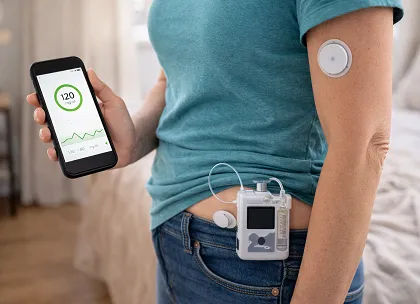
In a randomized, open-label, parallel-arm clinical trial, investigators evaluated whether an open-source automated insulin delivery (AID) system could maintain glycemic control without meal announcement compared with hybrid closed-loop (HCL) therapy requiring manual pre-meal insulin delivery. The results were published in the Diabetes Technology & Therapeutics. Adults aged 18–70 years with type 1 diabetes completed a 12-week run-in phase using the AID system with meal announcement, followed by a 12-week trial phase with 1:1 randomization to AID without meal announcement (n=36) or continued HCL (n=37).
The primary endpoint was percentage of time in the target glucose range (70–180 mg/dL [3.9–10.0 mmol/L]) during the final 14 days of the trial phase, adjusted for the same metric during the final 14 days of the run-in phase.
Mean±SD time in range at the end of the run-in and trial phases was 69±11% and 66±8% in the AID without meal announcement group, and 70±9% and 69±13% in the HCL group. The adjusted between-group difference was −2.2 percentage points (95% CI −6.2 to 1.7).
The study was limited by the fact that findings may not reflect real-world AID use.
In adults with type 1 diabetes, AID without meal announcement achieved a time in range comparable to HCL. These findings demonstrated glycaemic outcomes similar to HCL under controlled trial conditions.