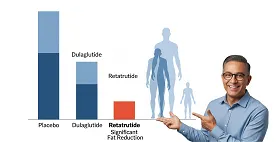
A new substudy of a phase 2 trial published in The Lancet: Diabetes and Endocrinology has revealed that retatrutide produces significant reductions in total body fat mass in adults with type 2 diabetes, compared to both placebo and dulaglutide.
The trial enrolled adults aged 18 to 75 years with type 2 diabetes, HbA1c levels between 7.0% and 10.5%, and BMI between 25 and 50 kg/m². Participants were randomized in a complex 2:2:2:1:1:1:1:2 ratio across different dosages of retatrutide (ranging from 0.5 mg to 12 mg weekly), placebo, or dulaglutide 1.5 mg. The primary endpoint was the percent change in total body fat mass from baseline to week 36, assessed using DXA scans.
Out of 534 screened patients, 281 were randomized into the main trial, and 189 were enrolled in this substudy focusing on body composition. A total of 103 participants completed both the baseline and week 36 DXA scans. The demographic breakdown of the substudy showed 56% women and 44% men, with the majority being White (85%), followed by Black (13%) and Asian (3%).
Results showed that the percent reduction in total fat mass from baseline to week 36 was highest with retatrutide 8 mg (26.1%) and 12 mg (23.2%). However, reductions were only 2.6% with dulaglutide and 4.5% with placebo. The least squares mean change compared to placebo confirmed these significant improvements, with -21.6% fat mass change (95% CI: -27.1 to -16.1; p<0.0001) at 8 mg and -18.7% (95% CI: -25.1 to -12.3; p<0.0001) at 12 mg. The change was -0.4 with retatrutide 0.5 mg and -10.7 with retatrutide 4 mg.
Safety outcomes were similar across all treatment arms. Serious adverse events were low. They occured in 0 to 9% of participants across different groups (9% cases in the retatrutide 8 mg and 3% cases in the retatrutide 12 mg group). Gastrointestinal symptoms were the most common side effects. No deaths were reported during the study.