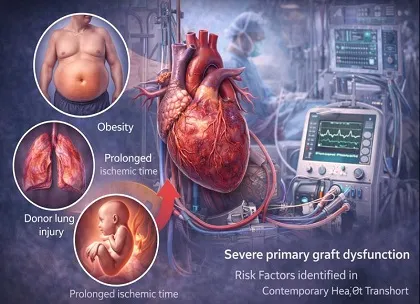
Severe primary graft dysfunction remains leading cause of early mortality following heart transplantation despite advances in donor management and mechanical circulatory support, occurring within 24 hours postoperatively through left or biventricular failure necessitating temporary mechanical support. Investigators conducted retrospective analysis of United Network for Organ Sharing database encompassing five thousand ninety-seven isolated adult heart transplant recipients from September 2023 through March 2025, stratifying into severe primary graft dysfunction cohort requiring mechanical circulatory support versus all remaining controls. The results were published in the Journal of Heart and Lung Transplantation.
Key Preoperative Predictors Established
Pretransplant extracorporeal membrane oxygenation exposure conferred adjusted odds ratio of 2.55 for severe primary graft dysfunction development alongside hearts procured following donation after circulatory death demonstrating 2.13-fold risk elevation and donor acidemia before procurement associating with 2.01 increased odds through ischemia-reperfusion injury potentiation. Recipient prior sternotomy history independently predicted graft dysfunction with adjusted odds ratio of 1.83, reflecting adhesions complicating intraoperative myocardial protection alongside ischemic preconditioning deficits.
Survival Disparities by PGD Duration
Severe primary graft dysfunction cohort exhibited markedly inferior three-month survival of 74.4% versus 96.8% among controls, confirming substantial early mortality burden despite contemporary mechanical circulatory support availability. Among three hundred thirty-eight affected recipients, 36.7% manifested transient primary graft dysfunction with rapid myocardial recovery permitting mechanical circulatory support weaning by seventy-two hours, achieving 88% three-month survival substantially exceeding persistent primary graft dysfunction cases remaining support-dependent at 67.2% survival.
Risk Mitigation Through Donor-Recipient Matching
Cardiothoracic transplant teams should integrate multivariable risk calculator incorporating extracorporeal membrane oxygenation status, donation after circulatory death procurement, donor acid-base status, and re-operative sternotomy history when constructing acceptable donor pools minimizing primary graft dysfunction incidence through precision matching paradigms.
Transient primary graft dysfunction recognition facilitates expectant management with temporary mechanical circulatory support bridging toward native recovery while persistent cases warrant expedited re-transplantation evaluation or durable left ventricular assist device conversion strategies optimizing long-term survival trajectories within constrained donor organ allocation frameworks.
Featured
Off
Page Content
#ffffff
Anonymous user
On
Authenticated user
On
Premium
On
Paid / Sponsored
On
Key highlights
- Severe primary graft dysfunction occurs in 6.6% of recent US heart transplants with 74.4% three-month survival versus 96.8% controls.
- Pretransplant extracorporeal membrane oxygenation doubles severe PGD risk through adjusted odds ratio of 2.55.
- Donation after circulatory death donors associate with 2.13-fold increased primary graft dysfunction odds.
- Transient PGD cases achieve 88% three-month survival versus 67.2% persistent cases requiring prolonged mechanical support.
- Donor acidemia and recipient prior sternotomy independently predict graft dysfunction through multivariable logistic regression.
Source
Cho PD, Zappacosta H, Song J, et al. Predictors and outcomes of severe primary graft dysfunction in heart transplantation: United States cohort analysis. The Journal of Heart and Lung Transplantation. 2026;45(1):16-25. doi: https://doi.org/10.1016/j.healun.2025.07.036
Thumbnail
Speciality
Currency
Sub Speciality
Sub Sub Speciality
Short Description
United Network for Organ Sharing analysis reveals 6.6% severe primary graft dysfunction incidence among 5,097 recent US heart transplants, with pretransplant ECMO and DCD donors doubling risk alongside 74.4% three-month survival.
User Segments
Release Date
Featured Order
0
Is Paid
0
Send Notification
Off