Doctors often see low hemoglobin in diabetes patients, especially when chronic inflammation raises C-reactive protein (CRP) levels. Does SGLT2 inhibitors like empagliflozin help raise hemoglobin in these cases?
A new matched cohort study from 2019-2023 tested this. Outpatient diabetes patients split into new SGLT2 users and never-users. Researchers matched pairs by propensity scores within low-CRP and high-CRP groups based on time-averaged levels. They compared hemoglobin at final visits for given kidney function (eGFR), plus changes in hemoglobin, CRP, and mean corpuscular volume (MCV) over time. Total pairs included 209 low-CRP and 127 high-CRP. The results were published in the Journal of Diabetes Investigation.
Hemoglobin Rises Across Inflammation Levels
New SGLT2 users showed higher hemoglobin at their last visit, no matter CRP status. Stats held for each eGFR level (P interaction 0.25). In the first 6 months, hemoglobin climbed in SGLT2 group while dropping in never-users. The gap grew bigger in high-CRP patients (P for 3-way interaction 0.02). CRP stayed flat regardless of drug use. MCV rose more in SGLT2 users with high CRP, hinting at bigger red blood cells.
Why This Helps Inflamed Diabetes Patients
SGLT2 drugs cut kidney stress and fluid shifts, likely boosting erythropoietin for red cell production. Inflammation usually suppresses this, but SGLT2 breaks through. Anemia hits tired, breathless diabetics hard—think your clinic patient with eGFR 45 and CRP 10 mg/L. Adding SGLT2 not only guards heart and kidneys but lifts hemoglobin too. No CRP drop needed; benefit comes direct.
Real Clinic Wins Without Extra Tests
From 1835 never-users and 690 new users, matching ensured fair groups. Robust models handled eGFR curves. Your next inflamed diabetic? Check hemoglobin trend 6 months post-SGLT2 start. Pairs fatigue with better energy, fewer transfusions. Safe across kidney ranges, matching heart failure gains.
Guide for Diabetes Management
Guidelines already push SGLT2 for cardiorenal protection. Add anemia fix to the list, especially high-CRP cases. Nephrologists: track hemoglobin with eGFR. Family docs: simple bloodwork shows wins.
This data arms the doctors: "Your inflammation lowers blood count, but SGLT2 raises it reliably." Patients feel results fast.
Featured
Off
Page Content
#ffffff
Anonymous user
On
Authenticated user
On
Premium
On
Paid / Sponsored
On
Key highlights
- SGLT2 inhibitor use raises hemoglobin levels at final visits regardless of high or low chronic inflammation (P interaction 0.25).
- Hemoglobin increases faster in new SGLT2 users during first 6 months compared to never-users, especially in high-CRP patients
- CRP levels remain stable with or without SGLT2 inhibitors, showing direct hemoglobin effects.
- Mean corpuscular volume rises more in SGLT2 users with higher inflammation, indicating larger red blood cells.
- Propensity-matched analysis confirms SGLT2 benefits persist across eGFR levels in inflamed diabetes patients.
Source
Murashima M, Suzuki K, Kasugai T, et al. Chronic inflammation is not associated with attenuated sodium-glucose co-transporter 2 inhibitor-induced hemoglobin increase in patients with diabetes. J Diabetes Investig. 2026 Jan;17(1):25-33. doi: https://doi.org/10.1111/jdi.70189
Thumbnail
Speciality
Currency
Sub Speciality
Sub Sub Speciality
Short Description
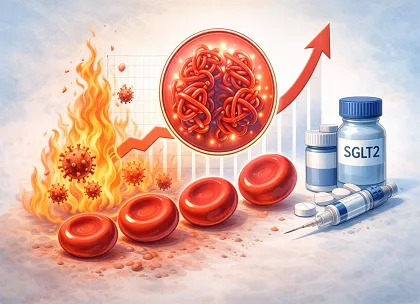
SGLT2 inhibitors boost hemoglobin in diabetes patients even with high inflammation, raising levels faster in first 6 months, especially in high-CRP cases, without changing CRP itself.
User Segments
Release Date
Featured Order
0
Is Paid
0
Send Notification
Off