Anxiety and Insomnia in Diabetes: A Hidden Comorbidity
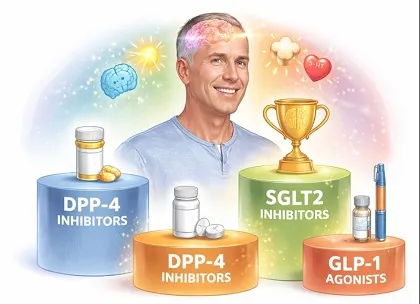
Type 2 diabetes patients face elevated anxiety and insomnia prevalence, yet comparative mental health outcomes across antihyperglycemic classes remain underexplored. This retrospective multicenter cohort study from the TriNetX US Collaborative Network and published in the Diabetes and Metabolic Syndrome examines sodium-glucose cotransporter 2 (SGLT2) inhibitors versus dipeptidyl peptidase-4 (DPP-4) inhibitors and glucagon-like peptide-1 receptor agonists (GLP-1 RAs) when added to metformin.
SGLT2 vs DPP-4: Dual Mental Health Benefit
Among 26,381 matched pairs of SGLT2 inhibitor and DPP-4 inhibitor users, SGLT2 inhibitors demonstrated lower incident anxiety rates (3.73% versus 4.82%; HR 0.87, 95% CI 0.80–0.95) alongside reduced insomnia risk (2.14% versus 2.73%; HR 0.89, 95% CI 0.80–0.99). These findings suggest SGLT2 inhibitors may offer dual cardiometabolic and mental health protection compared to DPP-4 inhibitors.
SGLT2 vs GLP-1 RA: Anxiety Advantage
In 24,794 matched pairs comparing SGLT2 inhibitors with GLP-1 receptor agonists, SGLT2 use again showed reduced anxiety risk (3.92% versus 5.29%; HR 0.79, 95% CI 0.72–0.85), though insomnia rates were statistically equivalent (HR 0.93, 95% CI 0.83–1.05). The anxiety benefit persisted across comparisons, positioning SGLT2 inhibitors favorably for neuropsychiatric outcomes.
Clinical Decision-Making Implications
Endocrinologists and primary care physicians gain new considerations when selecting second-line agents beyond A1c lowering. SGLT2 inhibitors emerge with consistent anxiety risk reduction versus both DPP-4 inhibitors and GLP-1 receptor agonists, plus insomnia benefit over DPP-4 inhibitors specifically. These mental health signals complement established cardiovascular and renal benefits.
Therapeutic Hierarchy Refinement
SGLT2 inhibitors strengthen their position not merely as cardiovascular-renal protective agents but as potential neuropsychiatric modulators in type 2 diabetes management. When anxiety screening identifies at-risk patients or insomnia burdens quality of life, SGLT2 inhibitors offer evidence-based mental health risk mitigation alongside metabolic control.
Featured
Off
Page Content
#ffffff
Anonymous user
On
Authenticated user
On
Premium
On
Paid / Sponsored
On
Key highlights
- SGLT2 inhibitors reduce anxiety risk (HR 0.87 vs DPP-4; HR 0.79 vs GLP-1 RA).
- SGLT2 inhibitors lower insomnia risk vs DPP-4 inhibitors (HR 0.89).
- No insomnia difference between SGLT2 inhibitors and GLP-1 RAs (HR 0.93).
- Mental health outcomes should influence antihyperglycemic agent selection.
Source
Chang CI, Lin JF, Chen IC, et al. Association of sodium-glucose cotransporter 2 inhibitors with the risk of incident anxiety and insomnia: a retrospective cohort study using the TriNetX database. Diabetes Metab Syndr. 2025 Dec 30;20(1):103373. Doi: https://doi.org/10.1016/j.dsx.2025.103373
Thumbnail
Speciality
Currency
Sub Speciality
Sub Sub Speciality
Short Description
SGLT2 inhibitors reduce anxiety risk compared to DPP-4 inhibitors and GLP-1 receptor agonists in type 2 diabetes patients, according to a large multicenter cohort study.
User Segments
Release Date
Featured Order
0
Is Paid
0
Send Notification
Off