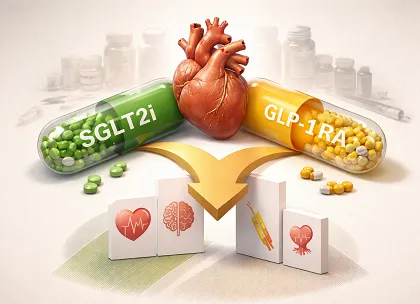
A massive new systematic review pooling 18 cohort studies with 1.16 million participants demonstrates that combining SGLT2 inhibitors and GLP-1 receptor agonists delivers superior cardiorenal protection compared to monotherapy with either agent alone. Published with data through May 2025, this analysis addresses the critical evidence gap around dual therapy's incremental benefit.
Unprecedented Scale: 1.16 Million Patients Across 18 Cohorts
Researchers systematically scoured PubMed and Embase from inception through May 1, 2025, identifying 18 high-quality cohort studies that directly compared SGLT2i + GLP-1RA combination versus monotherapy. The results were published in Diabetologia. Studies were rigorously filtered to exclude type 1 diabetes patients and those with <1-year follow-up, ensuring relevance to chronic T2D management. ROBINS-I assessed bias risk, while random-effects meta-analyses pooled risk ratios with GRADE certainty ratings. Primary outcome was MACE (myocardial infarction, stroke, CV death); secondary endpoints spanned mortality, HF hospitalization, kidney outcomes, and safety.
Combination Therapy Dominates Every Major Endpoint
Combination therapy slashed MACE risk by 44% versus monotherapy (RR 0.56, 95% CI 0.43-0.71; low certainty evidence). Kidney composite endpoints dropped even more dramatically (RR 0.48, 95% CI 0.32-0.73; very low certainty). All-cause mortality plunged (RR 0.50, 95% CI 0.40-0.63; low certainty), while cardiovascular mortality showed the largest relative risk reduction (RR 0.26, 95% CI 0.16-0.43; low certainty). HF hospitalization decreased by 33% (RR 0.67, 95% CI 0.64-0.71; moderate certainty)..
Safety Profile: No Red Flags in Individual Studies
Safety data couldn't be formally pooled due to low event rates, but individual studies consistently showed no increased risk of severe hypoglycemia, diabetic ketoacidosis, genitourinary infections, or gastrointestinal side effects compared to monotherapy. Notably absent were reports on serious adverse events or major adverse limb events, representing evidence gaps for future study. The tolerability profile supports combination as a viable intensification strategy without compromising safety.
Clinical Practice Revolution: Dual Therapy as New Standard?
This analysis emerges at a pivotal moment when guidelines increasingly endorse SGLT2i and GLP-1RA sequencing, yet combination timing remains debated. 1.16 million patients confirm additive benefit, with risk reductions rivaling landmark monotherapy trials. The 44% MACE reduction alone justifies earlier dual therapy consideration, particularly for T2D patients with established CVD, HF, or CKD. Moderate certainty for HF reduction provides strongest actionable evidence.
Featured
Off
Page Content
#ffffff
Anonymous user
On
Authenticated user
On
Premium
On
Paid / Sponsored
On
Key highlights
- Observational studies demonstrate that SGLT2 inhibitor + GLP-1 RA combination therapy lowers MACE risk by 44% (RR 0.56) compared to monotherapy in type 2 diabetes.
- Dual therapy reduces all-cause mortality (RR 0.50), cardiovascular mortality (RR 0.26), heart failure hospitalization (RR 0.67), and kidney composite endpoints (RR 0.48) versus either agent alone.
- No increased safety signals for severe hypoglycemia, diabetic ketoacidosis, genitourinary infections, or gastrointestinal side effects observed in individual studies.
Source
Colombijn JMT, de Leijer JF, Visseren FLJ, et al. Effectiveness and safety of combining SGLT2 inhibitors and GLP-1 receptor agonists in individuals with type 2 diabetes: a systematic review and meta-analysis of cohort studies. Diabetologia. 2026 Jan;69(1):36-49. Doi: https://doi.org/10.1007/s00125-025-06565-6
Thumbnail
Speciality
Currency
Sub Speciality
Sub Sub Speciality
Short Description
Largest real-world analysis shows dual therapy of combining SGLT2 inhibitors and GLP-1 receptor agonists outperforms monotherapy across mortality, HF, and kidney endpoints in type 2 diabetes.
User Segments
Release Date
Featured Order
0
Is Paid
0
Send Notification
Off