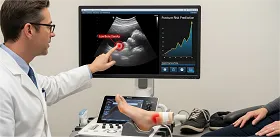
A low-cost, non-invasive bone test known as calcaneal quantitative ultrasound (QUS) may help predict long-term fracture risk in patients with type 2 diabetes (T2DM), according to a new 10-year study published in Clinical Endocrinology.
The study involved 300 individuals with either type 1 or type 2 diabetes who underwent heel ultrasound screening in 2013. Researchers collected baseline data on diabetes characteristics and QUS parameters, including broadband ultrasound attenuation (BUA), speed of sound (SOS), and stiffness index (SI).
At the time of initial assessment, 13% of the participants had already experienced at least one fragility fracture. These individuals showed significantly lower QUS values than those who had not fractured, in both the type 1 diabetes (T1DM) and T2DM groups.
Ten years later, researchers reconnected with 231 participants (132 with T2DM and 99 with T1DM) to document any new fragility fractures. About 13% reported a new fracture over the decade, and 6% experienced a major osteoporotic fracture (MOF), which includes fractures of the spine, hip, forearm, or shoulder.
The study found that lower BUA scores from the 2013 ultrasound were significantly associated with the occurrence of new major osteoporotic fractures in individuals with type 2 diabetes (p < 0.01). However, this link was not observed in those with type 1 diabetes, suggesting the tool may be more predictive for T2DM patients.