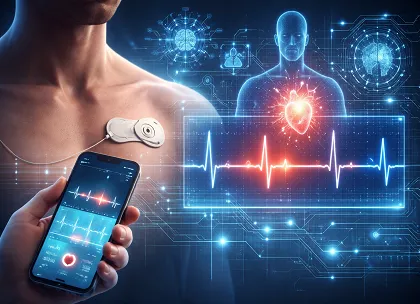
Cardiologists face a silent killer: drug-induced QT prolongation from class III antiarrhythmics like dofetilide and sotalol. These complications often emerge weeks after successful inpatient loading, during routine outpatient care when monitoring gaps prove fatal. Insertable cardiac monitors (ICMs) promised continuous surveillance but deliver only single-lead signals that are generally insufficient for accurate QTc assessment.
Study and Results
In a landmark study of 1,676 real-world outpatients on these drugs presenting to hospitals or ERs, researchers uncovered a shocking 16.5% prevalence of high-risk QTc prolongation. Ventricular arrhythmias struck 3.97% of these patients versus just 0.86% without prolongation, yielding an adjusted odds ratio of 4.24 (95% CI 1.81-9.90). This four-fold risk demands a monitoring breakthrough. The results were published in the Circulation.
3DRECON-QT: Reconstructing 12-Lead Power from One Wire
Enter 3DRECON-QT, a spatially aware deep learning system that transforms 10-second single-lead ECG signals into full 12-lead spatial reconstructions while predicting QT/QTc with precision. Developed using multitask encoder-decoder architecture trained on thousands of clinician-adjudicated 12-lead ECGs from a large health system, the model ingests nonstandard vectors and outputs both reconstructed leads and risk-stratified QTc values. Internal testing delivered an AUC of 0.942 (mean absolute error 17.5 ms) for prolonged QTc classification. External validation across different ECG hardware maintained AUC 0.943 (MAE 21.1 ms), proving hardware-agnostic reliability.
Battle-Tested Across Clinical Scenarios
Continuous monitoring validation used public dofetilide-loading datasets with serial ECGs, where predictions correlated tightly with ground truth (r=0.851, MAE 17.8 ms). The system excelled at detecting prolonged QTc (AUC 0.936) and critical ≥15% QTc rises (AUC 0.816). Real-world insertable cardiac monitor recordings paired with clinical 12-lead ECGs confirmed r=0.824 (MAE 17.5 ms) accuracy. High-risk detection in the 1,676-patient cohort achieved AUC 0.94 (F1 score 0.60). These metrics match traditional 12-lead performance from single-lead reality.
Transforming Post-Loading Workflow
Implementation proves seamless. After inpatient class III loading, implant standard ICMs and activate 3DRECON-QT analytics. Continuous 10-second signal windows generate real-time QTc alerts, flagging high-risk patients for dose adjustment, admission, or intervention. No more depending on infrequent office visits or symptom reports. This overcomes ICMs' fundamental single-lead limitation, enabling true continuous surveillance exactly when drug effects peak outpatient.
Guideline Accuracy Enables New Safety Standard
For atrial fibrillation or ventricular tachycardia patients requiring dofetilide or sotalol, 3DRECON-QT establishes the new safety paradigm. Every ICM becomes a virtual 12-lead guardian. With robust validation data across internal, external, continuous, and device-specific testing, this technology has the potential of shifting from research to routine practice, thereby potentially preventing countless admissions and saving lives.
Featured
Off
Page Content
#ffffff
Anonymous user
On
Authenticated user
On
Premium
On
Paid / Sponsored
On
Key highlights
- A single-lead deep learning approach achieves guideline-level QTc measurement accuracy from nonstandard ECG vectors such as insertable cardiac monitors.
- This technology enables continuous outpatient QTc surveillance to identify clinically meaningful prolongation linked to a greater than four-fold increase in serious ventricular arrhythmias.
- The strategy enhances safety monitoring specifically after initiation of class III antiarrhythmics like dofetilide and sotalol.
- It supports targeted clinical interventions by proactively identifying high-risk patients before arrhythmic events occur.
Source
Ansari RA, Bandyopadhyay S, Trivedi RK, et al. Deep Learning-Based Continuous QT Monitoring to Identify High-Risk Prolongation Events After Class III Antiarrhythmic Initiation. Circulation. 2026 Jan 6;153(1):35-46. Doi: https://doi.org/10.1161/CIRCULATIONAHA.125.077494.
Thumbnail
Speciality
Currency
Sub Speciality
Sub Sub Speciality
Short Description
Cardiologists can now detect deadly outpatient QT prolongation from dofetilide/sotalol using insertable cardiac monitors, significantly reducing ventricular arrhythmia risk through continuous surveillance.
User Segments
Release Date
Featured Order
0
Is Paid
0
Send Notification
Off