Simple Floor Test Beats Complex Scores
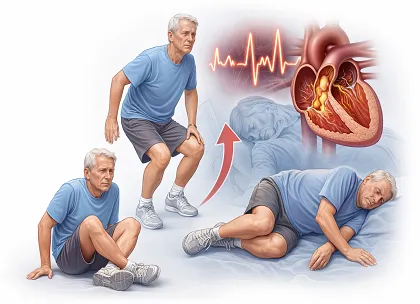
Doctors know aerobic fitness predicts heart risk but overlook basic movements. Sitting and rising from floor reveals strength, balance, and flexibility quickly. This test predicted death better than many biomarkers in prior work. Now researchers test cardiovascular outcomes specifically. The results of the study were published in European Journal of Preventive Cardiology.
Large Middle-Age Cohort Tested
Study followed 4,282 adults aged 46-75 years with 68% men prospectively. Participants scored sitting-rising test from 0 to 5 each way. They subtracted 1 point per hand or knee use and 0.5 for unsteadiness. Final score added sitting plus rising parts. Groups stratified as 0-4, 4.5-7.5, 8, 8.5-9.5, and 10 maximum.
Death Rates Climb Steadily Downward
Median follow-up lasted 12.3 years with interquartile range 7.6-18.0 years. Total deaths reached 665 or 15.5% of cohort. Mortality trended higher with lower scores and p less than 0.001. Death rates hit 42.1% in lowest group versus 3.7% in highest scorers.
Cox Models Confirm Strong Prediction
Multivariate Cox analysis adjusted for age, sex, body mass index, and clinical variables. Lowest versus highest SRT groups showed hazard ratio 3.84 with 95% CI 2.25-6.97 for natural death. Cardiovascular mortality hit HR 6.05 with 95% CI 2.29-20.94 and p less than 0.001.
Add SRT to Routine Exams
Primary care offices need no equipment for this test. Scores below 8 flag high-risk patients immediately. Combine with blood pressure and lipids for full assessment.
Trains What Medicine Misses
SRT captures muscular power and balance that treadmills ignore. Weak performers need strength training before drugs. Findings guide preventive cardiology directly.
Prognostic Power in 60 Seconds
One minute test adds mortality data beyond Framingham scores. Screen all adults over 45 yearly.
Featured
Off
Page Content
#ffffff
Anonymous user
On
Authenticated user
On
Premium
On
Paid / Sponsored
On
Key highlights
- Prospective cohort study followed 4,282 adults aged 46-75 years (68% men) who performed sitting-rising test scored 0-10 based on supports and unsteadiness over median 12.3 years.
- During follow-up, 665 deaths occurred (15.5%) with mortality rates of 3.7%, 7.0%, 11.1%, 20.4%, and 42.1% across SRT score groups from highest to lowest (p<0.001).
- Multivariate Cox analysis showed lowest SRT score group (0-4) carried HR 3.84 (95% CI 2.25-6.97) for natural mortality compared to highest scorers (10).
- Cardiovascular mortality hazard ratio reached 6.05 (95% CI 2.29-20.94, p<0.001) when comparing lowest versus highest sitting-rising test score groups after full adjustment.
- SRT provides significant prognostic information about muscular strength, flexibility, balance, and body composition for natural and CV mortality risk stratification in middle-aged adults.
Source
Araújo CGS, de Souza e Silva CG, Myers J, Laukkanen JA, Ramos PS, Ricardo DR. Sitting–rising test scores predict natural and cardiovascular causes of deaths in middle-aged and older men and women. European Journal of Preventive Cardiology. Published online June 18, 2025. doi: https://doi.org/10.1093/eurjpc/zwaf325
Thumbnail
Speciality
Currency
Sub Speciality
Sub Sub Speciality
Short Description
Cohort of 4,282 adults aged 46-75 finds lowest SRT scores (0-4) carry 42.1% death rate and 6.05 HR for CV mortality vs highest scorers over 12.3 years median follow-up.
User Segments
Release Date
Featured Order
0
Is Paid
0
Send Notification
Off