Researchers digging into the CONCORDANCE registry analyzed nearly 3,800 acute coronary syndrome patients referred to cardiac rehabilitation, tracking who signed up and how they fared at 12 months across socioeconomic lines. The results were published in the Journal of Cardiopulmonary Rehabilitation and Prevention.
Patients got sorted into five groups based on Australia's National Index of Relative Socio-Economic Disadvantage, from most disadvantaged (Q1) to least (Q5). Of those followed at six and 12 months, 48% actually joined rehab programs designed to rebuild strength, cut risks, and prevent repeat events through exercise, education, and counseling. The study used multilevel logistic regression to adjust for clinical histories and hospital differences, focusing on major adverse cardiovascular events (MACE)—like heart failure, new heart attacks, strokes, or cardiac deaths—and all-cause mortality.
Wealthier Patients Join Rehab More Often
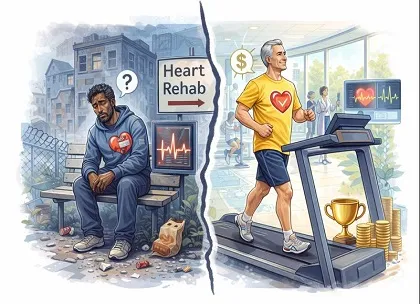
Signup rates varied sharply by income area: 61% in the least disadvantaged group (Q5), 53% in Q4, 42% in Q3, 47% in Q2, and 42% in the most disadvantaged (Q1). This gap shows how living in poorer neighborhoods ties to lower participation, perhaps from work demands, transport issues, or less awareness. Cardiologists see this pattern often, where social factors block access to proven therapies despite equal referrals. Boosting enrollment in lower-income groups could level the playing field for heart recovery.
Rehab Cuts Death Risk, Works Same for All
Among participants, MACE rates sat at 6% versus 8% for non-joiners, but odds showed no statistical edge (OR=0.87, 95% CI: 0.66-1.15). Death rates told a different story: just 0.4% for rehab attendees compared to 2% for others, slashing odds significantly (OR=0.35, 95% CI: 0.16-0.78). Crucially, these benefits held steady across socioeconomic quintiles, with no interaction effects (P=0.6943 for MACE, P=0.6339 for death). This means rehab delivers mortality wins regardless of wallet size, giving physicians solid data to push programs universally.
No Outcome Gaps By Income Level
Adjustments for age, prior conditions, and hospital clustering ensured fair comparisons, revealing rehab's equal punch across groups. Lower participation in disadvantaged areas didn't translate to worse outcomes for those who joined, suggesting the program itself erases socioeconomic divides once patients engage. Doctors can use this to advocate for support services like free transport or flexible scheduling to lift signup rates everywhere.
Time to Target Rehab Barriers Everywhere
These findings call for focused efforts to enroll more patients from all backgrounds, since skipping rehab doubles death odds no matter the zip code. Hospitals and clinics should roll out tailored outreach, partnering with communities to overcome hurdles. For the 1,834 who participated, clear survival gains prove rehab's worth, urging systems to make it the norm post-heart event.
Featured
Off
Page Content
#ffffff
Anonymous user
On
Authenticated user
On
Premium
On
Paid / Sponsored
On
Key highlights
- Cardiac rehab participation reached 48% overall, highest at 61% in least disadvantaged areas and lowest at 42% in most disadvantaged ones.
- Rehab participants faced similar MACE rates to non-participants at 12 months, with no significant odds reduction observed.
- Participation cut all-cause death odds by 65%, dropping from 2% to 0.4% compared to non-joiners.
- Socioeconomic status did not alter rehab's impact on MACE or mortality, showing equal benefits across income groups.
- Targeted efforts must boost enrollment in disadvantaged areas to maximize heart attack recovery gains for all patients.
Source
Manandi D, Brieger D, Redfern J, et al. Socioeconomic Variation in the Association Between Participation in Cardiac Rehabilitation and Clinical Outcomes in Patients With Acute Coronary Syndrome. J Cardiopulm Rehabil Prev. 2026 Jan 1;46(1):67-75. doi: https://doi.org/10.1097/HCR.0000000000000985.
Thumbnail
Speciality
Currency
Sub Speciality
Sub Sub Speciality
Short Description
Heart attack patients from wealthier areas join cardiac rehab more often, yet participation cuts death risk across all income levels with no outcome gaps by socioeconomic status.
User Segments
Release Date
Featured Order
0
Is Paid
0
Send Notification
Off