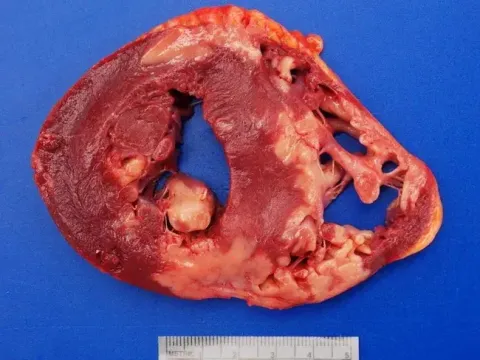
How can cardiac sarcoidosis be identified when myocardial tissue lacks visible granulomatous inflammation? In the European Heart Journal, high-plex spatial protein analysis was used to characterize the immunologic, fibrotic, and metabolic landscape of cardiac sarcoidosis (CS) using archival human cardiac tissue.
The retrospective tissue-based study analyzed cardiac samples from 64 patients, including 39 with CS and 25 controls without CS. Tissue sections underwent spatial protein profiling using a high-plex digital spatial analysis platform. Regions of interest (ROIs) with and without granulomatous inflammation were selected. ROIs were further subdivided into areas of illumination to separately analyze protein abundance in myocytes, stroma, and vascular compartments. A 79-protein panel characterized immune and parenchymal cell populations. Differential protein abundance was evaluated using mixed-effects modeling.
Spatial proteomic analysis demonstrated marked heterogeneity within individual sarcoidosis granulomas and between granulomas. In inflammation-free ROIs from CS hearts, protein abundance varied according to proximity to granulomatous inflammation, forming a distance-dependent gradient. A predictive model incorporating seven proteins differentiated inflammation-free CS ROIs from control ROIs with 95.9% accuracy and an area under the receiver operating characteristic curve of 0.993.
Spatial proteomics identified a distinct immune signature in CS tissue lacking overt inflammation and provided diagnostic information relevant to myocardial biopsy evaluation.