The Critical Population and Trial Design
STORM-PE randomized 100 adults across 22 international sites who had acute-onset intermediate-high risk PE (symptoms ≤14 days), RV/LV ratio ≥1.0 on CT pulmonary angiography, elevated cardiac biomarkers, and remained normotensive. Patients received either CAVT plus anticoagulation (n=47) or anticoagulation monotherapy (n=53), with baseline characteristics comparable between groups. The results were published in the Circulation.
The primary endpoint measured the change in the RV/LV ratio at 48 hours, assessed by a blinded independent core laboratory. Secondary endpoints included major adverse events within 7 days (clinical deterioration requiring rescue therapy, PE-related mortality, recurrent PE, major bleeding), adjudicated by an external clinical events committee.
Primary Endpoint: Twice the RV Recovery
At 48 hours, CAVT demonstrated clear superiority for right ventricular unloading. In the CAVT arm, the RV/LV ratio decreased by 0.52 ± 0.37, while in the anticoagulation-alone arm, it decreased by 0.24 ± 0.40. The treatment difference was 0.27 (95% CI, 0.12–0.43; P < 0.001).
Supporting imaging confirmed greater reductions in pulmonary artery obstruction, with refined modified and modified Miller scores showing significantly larger improvements in the CAVT arm (both P < 0.001).
Clinical Recovery and Vital Signs
CAVT patients achieved earlier normalization of vital signs within 48 hours compared to anticoagulation alone, reflecting more rapid hemodynamic recovery despite identical baseline characteristics.
Safety Profile: Comparable Major Adverse Events
The 7-day major adverse event rate showed no significant difference in the CAVT and anticoagulation-alone arm (4.3% vs 7.5%, respectively) (P=0.681). Two PE-related deaths occurred in the CAVT arm, but overall safety equivalence was maintained.
Clinical Implications
STORM-PE establishes that CAVT plus anticoagulation rapidly relieves acute RV pressure overload in intermediate-high risk PE patients, achieving twice the RV/LV ratio reduction at 48 hours compared to anticoagulation monotherapy. The intervention demonstrates comparable safety to standard therapy while accelerating hemodynamic recovery, a critical advantage for patients at risk of early clinical decompensation.
For clinicians managing normotensive PE patients with RV/LV ratio ≥1.0 and elevated biomarkers, STORM-PE provides Level 1 evidence supporting mechanical thrombectomy as superior to anticoagulation alone for achieving rapid RV recovery during the high-risk 48-hour window.
Featured
Off
Page Content
#ffffff
Anonymous user
On
Authenticated user
On
Premium
On
Paid / Sponsored
On
Key highlights
- CAVT reduced the RV/LV ratio more effectively than anticoagulation alone within 48 hours in intermediate-high risk PE patients.
- CAVT was associated with earlier normalization of vital signs compared with anticoagulation alone.
- The rate of major adverse events with CAVT was comparable to that observed with anticoagulation alone.
Source
Lookstein RA, Konstantinides SV, Weinberg I, et al. Randomized Controlled Trial of Mechanical Thrombectomy With Anticoagulation Versus Anticoagulation Alone for Acute Intermediate-High Risk Pulmonary Embolism: Primary Outcomes From the STORM-PE Trial. Circulation. 2026 Jan 6;153(1):21-34. doi: https://doi.org/10.1161/CIRCULATIONAHA.125.077232
Thumbnail
Speciality
Currency
Sub Speciality
Sub Sub Speciality
Short Description
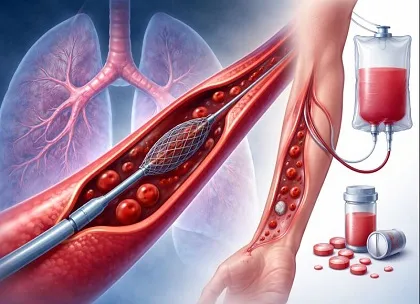
The STORM-PE trial provides the first randomized controlled evidence that computer-assisted vacuum thrombectomy (CAVT) plus anticoagulation significantly outperforms anticoagulation alone for rapid right ventricular unloading in normotensive patients with intermediate-high risk pulmonary embolism (PE).
User Segments
Release Date
Featured Order
0
Is Paid
0
Send Notification
Off