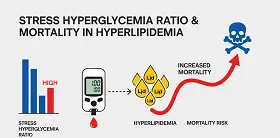
An extensive ICU database analysis has found that elevated Stress Hyperglycemia Ratio (SHR) is strongly associated with higher mortality in patients hospitalized with hyperlipidemia. SHR is a measure of stress-related blood sugar elevation.
The findings suggest SHR could be a valuable tool for improving risk prediction in this population. The analysis was published in Diabetes Research and Clinical Practice.
The study analyzed data from 4,883 first-admission hyperlipidemia patients in the Medical Information Mart for Intensive Care IV (MIMIC-IV) database. The mean age of the participants was 70 years. Patients were divided into quartiles based on SHR levels, and mortality outcomes were assessed for ICU stay, hospital stay, and 28-day follow-up.
Higher SHR was independently linked to worse outcomes. The ICU mortality had an HR of 1.29, the in-hospital mortality had an HR of 1.24, and the 28-day mortality had an HR of 1.32. The study found a linear relationship between SHR and mortality risk.
There was a significant improvement in the accuracy when SHR was added to standard predictive models. LightGBM indicated SHR as a key predictor.
Featured
Off
Page Content
#ffffff
Anonymous user
On
Authenticated user
On
Premium
On
Paid / Sponsored
On
Key highlights
- Higher SHR was associated with increased ICU, in-hospital, and 28-day mortality.
- Risk association was found to be linear across SHR levels.
- Adding SHR to predictive models improved accuracy.
- Machine learning confirmed SHR as a strong risk indicator.
- The study may assist the clinicians in early identification and management of high-risk patients.
Source
Hu B, Yang Z, Yuan L, et al. Assessing the stress hyperglycemia ratio in hyperlipidemia patients to predict all-cause mortality: A retrospective cohort study. Diabetes Res Clin Pract. 2025;226:112301. doi: https://doi.org/10.1016/j.diabres.2025.112301
Thumbnail
Speciality
Currency
Sub Speciality
Sub Sub Speciality
Short Description
Higher Stress Hyperglycemia Ratio is strongly linked to higher mortality in patients hospitalized with hyperlipidemia.
User Segments
Release Date
Featured Order
0
Is Paid
0