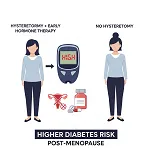
A new study involving over 127,000 postmenopausal women from the UK Biobank has identified a higher risk of developing type 2 diabetes mellitus (T2DM) associated with female-specific factors, namely hysterectomy, bilateral oophorectomy, and hormone replacement therapy (HRT). The findings were published in Clinical Endocrinology.
Women who had undergone hysterectomy alone faced a 20% increased risk of developing T2DM than those without the procedure. Those who had both hysterectomy and bilateral oophorectomy also showed a 19% higher risk.
The study reported that HRT use was independently associated with an 8% increased risk of T2DM. However, this association was not uniform across all women. The elevated risk with HRT use was limited to women with no history of hysterectomy or oophorectomy. The risk was the most in those who began HRT before age 45 (27% increased risk). In contrast, women over 45 who used HRT did not experience a significant rise in T2DM risk.