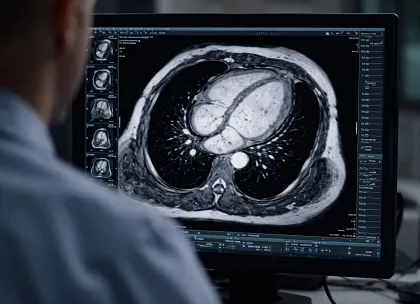
Microvascular obstruction (MVO) after ST-elevation myocardial infarction (STEMI) remains a major determinant of adverse myocardial remodeling, but the long-term impact of thrombus aspiration during primary percutaneous coronary intervention (PCI) remains uncertain. A single-center observational cohort study published in the International Journal of Cardiology evaluated serial cardiac magnetic resonance (CMR) findings in patients with STEMI undergoing primary PCI with or without thrombus aspiration.
The analysis included 130 patients, including 84 treated with PCI plus thrombus aspiration and 46 treated with PCI alone. Baseline and 12-month CMR assessments included infarct size measured by late gadolinium enhancement (LGE), MVO, left ventricular volumes, ejection fraction, and global longitudinal strain.
Findings
- Patients undergoing PCI plus thrombus aspiration had higher baseline thrombus burden than PCI-alone patients (TIMI thrombus grade 5 [5;5] vs. 3 [2;5]; p < 0.001).
- Baseline MVO prevalence was higher in the thrombus aspiration group (44.6% vs. 25%; p = 0.03).
- Baseline infarct size was larger among patients treated with thrombus aspiration (24.2% vs. 17.5% of left ventricular myocardial mass; p = 0.001).
- At 12 months, greater reduction in myocardial scar burden was observed in the PCI plus thrombus aspiration group compared with PCI alone (−5.0% [−21.8; 1.4] vs. −3.28% [−17.9; 4.6]; p < 0.05).
- Scar reduction appeared more pronounced in patients with high thrombus burden and baseline MVO (−10.3% [−19.8; −2.5] vs. −3.7% [−9.5; 1.2]; p < 0.05).
The findings suggest that despite worse baseline angiographic and imaging characteristics, patients undergoing thrombus aspiration experienced a greater reduction in myocardial scar burden over 12 months.