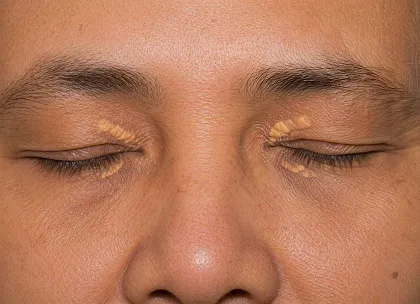
Visible xanthelasma may be associated with higher long-term vascular risk. A retrospective cohort analysis using the TriNetX electronic health record (EHR) network evaluated the association between xanthelasma and major adverse cardio-cerebrovascular events (MACCEs). The findings were published in Atherosclerosis.
Adults diagnosed with xanthelasma were identified and compared with controls who had presbyopia without xanthelasma. Patients with prior myocardial infarction (MI), ST-elevation myocardial infarction (STEMI), non-ST-elevation myocardial infarction (NSTEMI), stroke, or transient ischemic attack (TIA) before the index diagnosis were excluded from both cohorts. After 1:1 propensity score matching (PSM), 17,925 patients remained in each group with at least 12 months of follow-up.
Event rates were assessed at 1-, 5-, and 10-year intervals, and Kaplan-Meier analysis with log-rank testing was applied. At 1 year, the xanthelasma cohort had higher incidence of MI (1.00% vs 0.35%; hazard ratio [HR] 2.92, 95% confidence interval [CI] 2.20–3.90), stroke (0.95% vs 0.30%; HR 3.35, 95% CI 2.44–4.52), and TIA (0.60% vs 0.19%; HR 3.29, 95% CI 2.24–4.84). At 5 years, higher rates persisted for MI (2.26% vs 1.13%; HR 2.24, 95% CI 1.89–2.65), stroke (2.25% vs 1.03%; HR 2.46, 95% CI 2.06–2.93), and TIA (1.60% vs 0.74%; HR 2.41, 95% CI 1.96–2.97).
At 10 years, rates remained higher for MI (3.13% vs 1.73%; HR 2.14, 95% CI 1.85–2.45), stroke (3.00% vs 1.53%; HR 2.32, 95% CI 2.00–2.70), and TIA (2.00% vs 1.13%; HR 2.10, 95% CI 1.75–2.50). All between-group differences were statistically significant (p<0.0001).
These findings indicate a consistent association between xanthelasma and higher cardio-cerebrovascular event rates over time. Xanthelasma may serve as a visible clinical marker that could prompt broader cardiovascular risk assessment and preventive management.