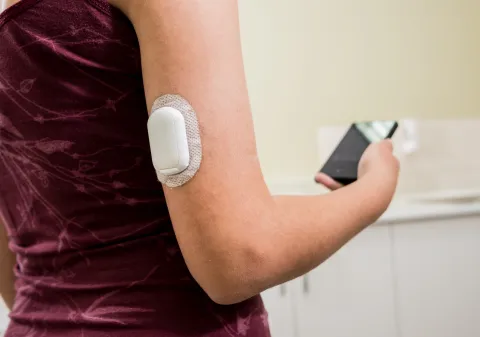
For children and adults with type 1 diabetes mellitus (T1DM) who have suboptimal glycemia on multiple daily injections (MDI), treatment intensification remains a clinical challenge. An open-label, multicenter, randomized controlled trial published in The Lancet Diabetes & Endocrinology evaluated the safety and efficacy of a tubeless automated insulin delivery (AID) system compared with continued MDI in this population.
The RADIANT trial was conducted across 19 hospitals in the United Kingdom, Belgium, and France. Participants aged 4-70 years with T1DM treated with MDI and continuous glucose monitoring, and with glycated hemoglobin (HbA1c) levels of 7.5% to 11% (58-97 mmol/mol), were randomly assigned in a 2:1 ratio to tubeless AID (n = 125) or control (MDI; n = 63). The primary outcome was the adjusted between-group difference in HbA1c at 13 weeks, assessed for superiority in the modified intention-to-treat population.
At baseline, the mean HbA1c was 8.1% in both groups. At 13 weeks, HbA1c decreased to 7.2% SD 0.6; 55 mmol/mol [SD 6.6]) in the AID group and to 8.0% (SD 0.7; 64 mmol/mol [SD 7.7]) in the control group. The adjusted mean difference was −0.8% (95% CI, −1.0 to −0.6; −8.7 mmol/mol [95% CI, −10.9 to −6.6]; p < 0.0001).
During the 13-week trial, no episodes of severe hypoglycemia or diabetic ketoacidosis occurred in either group. Thirty-nine adverse events were reported among 28 participants in the AID group, compared with three adverse events among three participants in the control group. Two serious adverse events, Kawasaki disease and acute coronary syndrome, occurred in the AID group and were unrelated to the study device or procedure.
These findings show the clinical efficacy of direct transition from MDI to tubeless AID in adults and children with T1DM, with no safety concerns observed during the trial period.