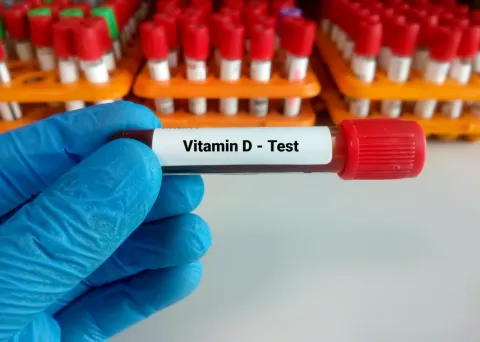
Vitamin D deficiency remains common in people with type 2 diabetes mellitus (T2DM) and may influence metabolic, inflammatory, and endocrine pathways. A cross-sectional study published in Frontiers in Endocrinology evaluated associations between serum 25-hydroxyvitamin D [25(OH)D] levels and markers of calcium metabolism, inflammation, thyroid function, and thyroid autoimmunity in adults with T2DM.
The study enrolled 503 adults with T2DM. Participants were stratified into four groups according to serum 25(OH)D levels: severe deficiency (<10 ng/mL), moderate deficiency (10-20 ng/mL), insufficiency (20-30 ng/mL), and sufficiency (>30 ng/mL). Clinical and biochemical parameters were compared across vitamin D categories and according to thyroid peroxidase antibody (TPOAb) and thyroglobulin antibody (TGAb) status.
Findings
- Vitamin D deficiency, defined as 25(OH)D below 20 ng/mL, was present in 83.7% of participants.
- Higher 25(OH)D levels were associated with lower parathyroid hormone (PTH) levels (P = 0.010) and higher calcium levels (P < 0.001).
- High-sensitivity C-reactive protein (hsCRP) levels peaked in the moderate deficiency group at 2.66 mg/L (P < 0.001).
- Triiodothyronine (T3) and free triiodothyronine (fT3) levels peaked in the insufficiency group and were lowest in participants with severe deficiency (P < 0.05).
- TGAb-positive participants had higher 25(OH)D levels than TGAb-negative participants (13.45 vs 12.00 ng/mL; P = 0.008). In contrast, TPOAb-positive participants had lower 25(OH)D levels than TPOAb-negative participants (11.90 vs 12.85 ng/mL; P < 0.001).
- No significant associations were observed between 25(OH)D levels and hemoglobin A1c (HbA1c), body mass index (BMI), thyroid-stimulating hormone (TSH), or bone turnover markers.
The analysis showed that vitamin D deficiency was highly prevalent in adults with T2DM and was associated with altered calcium-parathyroid hormone homeostasis, inflammatory activity, and lower T3 levels. Differing associations with thyroid autoantibodies also suggested a potential link between vitamin D status and thyroid autoimmunity in this population.