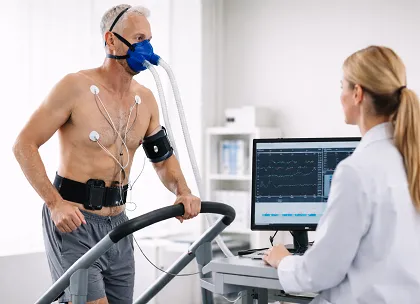
Current guidelines recommend referral for heart transplantation in ambulatory Heart Failure (HF) when peak oxygen consumption (peak VO2) is <12 mL/kg/min, based on historical data. This retrospective analysis published in the Heart examined whether peak VO2 alone remains prognostically sufficient in contemporary HF management.
Among 8,060 ambulatory HF patients with cardiopulmonary exercise testing (CPET), 1,218 with left ventricular ejection fraction <40% and peak VO2 <12 mL/kg/min (2010–2022) comprised the primary cohort. The composite outcome was death, left ventricular assist device (LVAD), or heart transplantation. Survival was compared with heart transplantation recipients from the International Society for Heart and Lung Transplantation registry. Patients were stratified by ventilatory efficiency (ventilation to carbon dioxide production slope [VE/VCO2] >34 vs ≤34) and presence of exercise oscillatory ventilation (EOV).
Patients with peak VO2 <12 mL/kg/min had better survival than transplant recipients, with curves intersecting at approximately 2.7 years. Among those with VE/VCO2 ≤34, 10-year mortality risk was reduced by 50% (p<0.01), with survival curves crossing transplant recipients around year 4.
Absence of EOV was also associated with a 50% lower long-term mortality. Combining VE/VCO2 and EOV identified four risk groups with significantly different 10-year outcomes (p<0.01). Patients with peak VO2 <12 mL/kg/min, VE/VCO2 ≤34, and no EOV had survival comparable to transplant recipients at year 5.
Peak VO2 <12 mL/kg/min alone may not identify sufficiently high short-term mortality risk. VE/VCO2 and EOV provided incremental risk stratification in ambulatory HF.