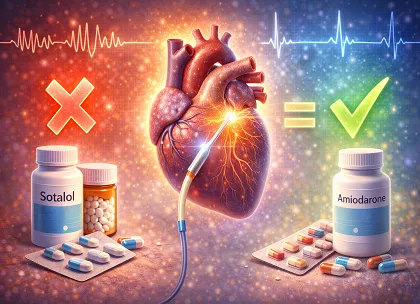
Ventricular tachycardia after myocardial infarction carries high mortality risk despite implantable cardioverter-defibrillator therapy, prompting the VANISH2 trial to compare catheter ablation with antiarrhythmic drugs stratified by patient suitability. This prespecified substudy published in the Journal of American Colege of Cardiology analyzed outcomes by drug eligibility: sotalol-eligible patients met criteria including eGFR ≥30 mL/min, NYHA class I-II, LVEF ≥20%, no VT storm, and no torsades history; others qualified for amiodarone versus ablation.
The primary endpoint comprised death, appropriate ICD shock, VT storm, or treated sustained VT below detection >14 days postrandomization. Secondary endpoints included individual components and safety events. Among 416 patients followed median 4.3 years, investigators compared ablation versus sotalol in 199 lower-risk patients and versus amiodarone in 217 higher-risk patients.
Sotalol Stratum Favors Ablation Efficacy
In the sotalol-eligible group, primary endpoint occurred in 46% of 95 ablation patients versus 59% of 104 sotalol patients, yielding hazard ratio 0.64 with 95% confidence interval 0.43-0.94 and P=0.02. Sustained VT below detection proved markedly lower at 2.1% versus 17.3% (HR 0.12, 95% CI 0.03-0.5, P=0.004), demonstrating superior VT suppression.
Amiodarone Stratum Shows Equipoise
Among amiodarone-eligible patients, primary endpoint rates were similar: 55% in 108 ablation patients versus 61% in 109 amiodarone patients (HR 0.86, 95% CI 0.61-1.22, not significant). Subthreshold VT occurred less frequently with ablation at 6.5% versus 15.6% (HR 0.41, 95% CI 0.17-0.99, P=0.048).
Drug Arm Highlights Toxicity Burden
Amiodarone allocation associated with excess noncardiac mortality (16.5% versus 5.6%), doubled respiratory failure (11.0% versus 4.6%), 50% higher heart failure hospitalization (31.2% versus 19.4%), increased sepsis (9.2% versus 5.6%), tripled pneumonia (11.9% versus 3.7%), and 4.6% pulmonary fibrosis incidence absent in ablation patients.
Risk-Stratified VT Management Implications
Electrophysiologists gain evidence supporting ablation as first-line over sotalol in suitable post-MI VT patients, with comparable efficacy to amiodarone in sicker cohorts but superior safety profile. Drug eligibility guides procedural planning while highlighting amiodarone toxicities in frail populations.
Featured
Off
Page Content
#ffffff
Anonymous user
On
Authenticated user
On
Premium
On
Paid / Sponsored
On
Key highlights
- In sotalol-eligible stratum, ablation reduces primary endpoint versus sotalol (46% vs 59%, HR 0.64, 95% CI 0.43-0.94, P=0.02).
- Subthreshold sustained VT drops markedly with ablation versus sotalol (2.1% vs 17.3%, HR 0.12, P=0.004).
- Amiodarone stratum shows equivalent primary endpoint rates between ablation and drug (55% vs 61%, HR 0.86, P=NS).
- Amiodarone patients experience tripled noncardiac death (16.5% vs 5.6%) and increased pulmonary complications versus ablation.
- Ablation offers superior safety over amiodarone with comparable VT control in higher-risk post-MI patients.
Source
Nery, P, Wells, G, Tang, A. et al. Catheter Ablation vs Sotalol or Amiodarone for Ventricular Tachycardia: A Substudy of the VANISH2 Trial. JACC. 2026 Jan, 87 (2) 157–168. https://doi.org/10.1016/j.jacc.2025.09.1595
Thumbnail
Speciality
Currency
Sub Speciality
Sub Sub Speciality
Short Description
VANISH2 substudy shows catheter ablation reduces primary VT endpoint versus sotalol in drug-eligible patients (HR 0.64, P=0.02) but equals amiodarone in higher-risk strata with fewer drug toxicities.
User Segments
Release Date
Featured Order
0
Is Paid
0
Send Notification
Off