Type 2 diabetes management frequently incorporates artificial sweetened beverages (ASB) as calorie-free alternatives to sugar-sweetened drinks, yet clinical impact upon glycemic control remains uncertain despite physiologic concerns regarding non-nutritive sweetener effects upon glucose homeostasis and insulin sensitivity.
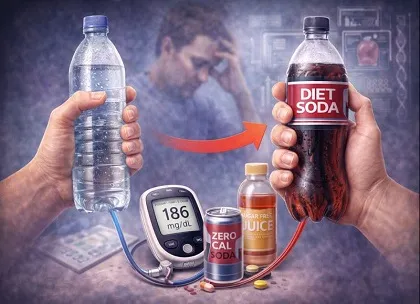
In a study published in the Diabetes Care, the investigators conducted Study of Drinks with Artificial Sweeteners (SODAS) in People with T2D across two academic health centers as randomized two-arm parallel trial enrolling 181 adults aged 35 years or older with hemoglobin A1c between 6.5% and 8.5% who regularly consumed commercial ASB, implementing two-week run-in period followed by 24-week active intervention substituting 24 oz daily habitual intake with either commercial artificial sweetened beverage of choice or unflavored sparkling or still bottled or canned water.
Primary endpoint focused upon hemoglobin A1c trajectory alongside secondary assessments encompassing fructosamine, fasting glucose and insulin concentrations, body weight evolution, and continuous glucose monitor derived metrics captured at baseline, 12 weeks, and 24 weeks through standardized laboratory and biometric protocols.
Unexpected HbA1c Elevation in Water Substitution Arm
Intent-to-treat analysis of 179 participants completing protocol demonstrated mean hemoglobin A1c difference of 0.29% with standard error 0.12 favoring ASB continuation over water substitution at P=0.013, contradicting physiologic rationale anticipating superior glycemic stability through complete non-nutritive sweetener elimination. This counterintuitive finding suggests potential unmasking of underlying carbohydrate substitution behaviors or ASB mediated cephalic phase insulin suppression preservation among habitual consumers maintaining glycemic setpoints through conditioned responses.
Secondary Measures Align Directionally Without Statistical Significance
Fructosamine, fasting glucose, insulin levels, body weight parameters, and continuous glucose monitor metrics exhibited trends consistent with primary endpoint through numerically greater deterioration within water substitution cohort. This reinforces biological plausibility of observed hemoglobin A1c divergence across multiple glycemic exposure surrogates despite lacking individual statistical power for secondary inferences.
Implications for Artificial Sweetened Beverage Counseling
Endocrinologists confronting motivated type 2 diabetes patients consuming ASB regularly should maintain current beverage substitution counseling absent contradictory randomized evidence, recognizing 24 oz daily volume represents moderate intake insufficient to precipitate clinically meaningful metabolic derangements among hemoglobin A1c controlled cohorts averaging below 8.5%.
Featured
Off
Page Content
#ffffff
Anonymous user
On
Authenticated user
On
Premium
On
Paid / Sponsored
On
Key highlights
- Water substitution for 24 oz daily ASB intake produces 0.29% higher HbA1c increase versus continued ASB over 24 weeks in T2D adults.
- SODAS trial enrolls 181 patients aged ≥35 years with HbA1c 6.5-8.5% across two academic centers confirming feasibility.
- Secondary measures including fructosamine, fasting glucose, insulin, weight, and CGM metrics trend consistent with primary endpoint directionally.
- No evidence supports water substitution improving glycemic control among regular ASB consumers with controlled T2D.
- Habitual ASB intake demonstrates metabolic neutrality within moderate 24 oz daily consumption patterns over 24-week intervention.
Source
Odegaard AO, Chang J, Jiang L, et al. The Effect of Substituting Water for Artificially Sweetened Beverages on Glycemic and Weight Measures in People With Type 2 Diabetes: The Study of Drinks With Artificial Sweeteners (SODAS), a Randomized Trial. Diabetes Care. 2025;49(2):239-246. doi: https://doi.org/10.2337/dc25-1516
Thumbnail
Speciality
Currency
Sub Speciality
Sub Sub Speciality
Short Description
SODAS trial reveals substituting water for artificial sweetened beverages yields 0.29% higher HbA1c increase versus continued ASB consumption over 24 weeks in 179 T2D adults with HbA1c 6.5-8.5%.
User Segments
Release Date
Featured Order
0
Is Paid
0
Send Notification
Off