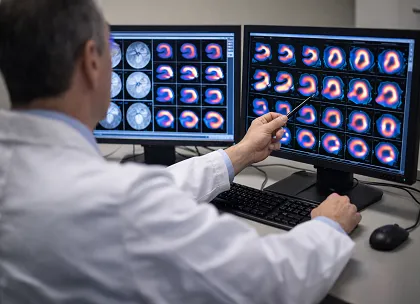
In stable obstructive coronary artery disease (coronary artery disease [CAD]), revascularization has not been shown to improve clinical outcomes but may reduce angina burden. An analysis published in Circulation Cardiovascular Imaging evaluated whether changes in angina symptoms after revascularization were associated with the severity of myocardial perfusion defects and changes in myocardial perfusion.
The analysis included data from two trials, ISCHEMIA (International Study of Comparative Health Effectiveness With Medical and Invasive Approaches) and Dan-NICAD (Danish Study of Noninvasive Testing in Coronary Artery Disease).
Eligible participants included stable patients with new-onset chest pain suggestive of obstructive CAD and single-vessel disease who underwent nuclear myocardial perfusion imaging (nMPI). In ISCHEMIA, patients with moderate to severe ischemia were randomized to optimal medical therapy (OMT) alone or OMT with invasive angiography. In Dan-NICAD, patients with suspected stenosis on coronary computed tomographic angiography underwent nMPI, with revascularization guided independently of nMPI findings and blinded to imaging results; those with abnormal baseline nMPI were reassessed at 12 months. The primary endpoint was change in Seattle Angina Questionnaire (SAQ) angina frequency score.
A total of 584 patients were analyzed. Revascularization was associated with improvement in angina frequency scores in patients with summed difference scores (SDS) of 5–<10 (mean change 16.4±20.9) and ≥10 (19.0±24.1). No improvement was observed in patients with SDS <5. In multivariable logistic regression analysis (n=91), increased hyperemic myocardial blood flow at follow-up was associated with freedom from angina (odds ratio 2.89; 95% CI 1.04–8.70).
nMPI-defined ischemia severity was associated with symptom improvement following revascularization. These findings suggest that ischemia severity on nMPI is associated with symptom improvement following revascularization.